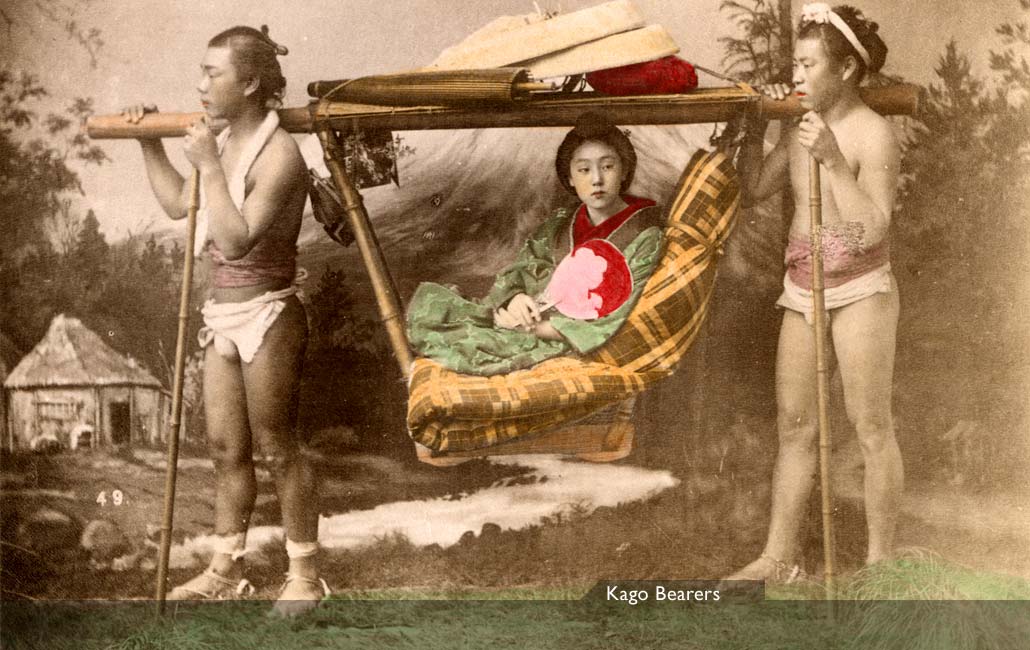
Kago
“The kago is an instument of torture, carried on the shoulders of two or more men by bamboo poles. To appreciate the feeling of the inmate of a kago for an hour’s ride, one must sit on the floor with his back propped against the wall that space of time, but the jolting and jerking must be drawn on the imagination.”

“The Inquisition should have been put in possession of the Japanese kago as a lesser punishment for its heretics, so exquisite and insidious are its tortures. The kago is a shallow basket with a high back, slung from a pole carried on the shoulders of two men, and in the mountains and remote districts is the only means of travel, except for pack-horses. The Japanese double their knees and sit on their feet with great dignity and apparent comfort; but the greater size of the foreigner, his stiff joints and higher head, prevent his fitting into the kago; nor is he much better off when he gets astride, dangling his long legs over the edges. Moreover, he not only knows that he looks ridiculous, but suffers the pangs of conscience for imposing his weight on two small coolies no larger than the ten-year-old boys of his own land.”
Arthur H. Crow, Highways and Byeways in Japan, (London, 1883) pp. 224–25
Eliza Ruhamah Scidmore, Jinrikisha Days in Japan, (New York, 1891) pp. 162–65