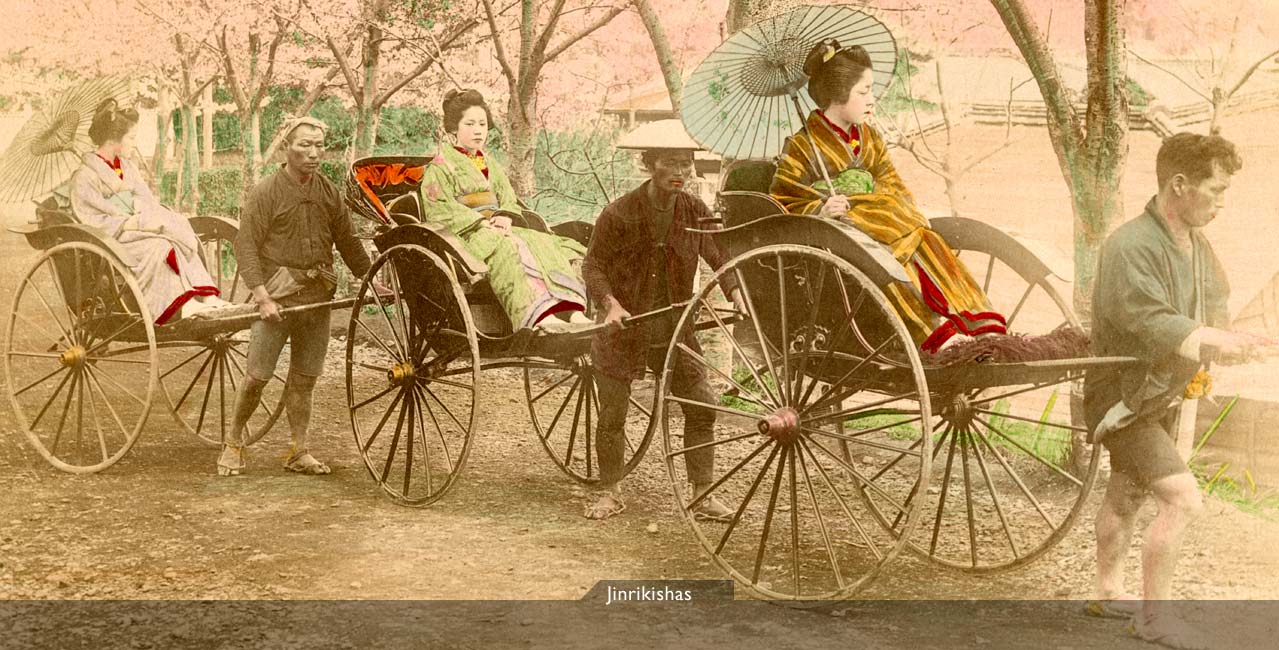
Jinrikisha
“As the kago gave way to the jinrikisha, the jinrikisha disappears before the steam engine … Before the iron horse had cleared all the picturesqueness from the region three of us made the jinrikisha journey down the Tokaido.”

“To the majority of travelers the jinrikisha is a novel mode of conveyance; there is something exhilarating about it. It awakens the boy in you, and you are prompted to shout aloud in very glee. The little car is so diminutive, so toylike, so far removed from the ponderous equipage of the Western world with which you are familiar, that you feel strangely out of place seated in its Lilliputian arm-chair. The fear of breaking it is never far absent from your mind. And then, too, its owner—the human steed—is so akin to all that you have connected to childhood that you feel as if you were ‘playing a game’ and a dreadful fear besets you that soon he will put down the tiny shafts and inform you that it is now your turn to be ‘the horse.’”
(
More)
Eliza Ruhamah Scidmore, Jinrikisha Days in Japan, (New York, 1891) pp. 189–90
Gilbert Watson, Three Rolling Stones in Japan, (London, 1904) p. 10
Jinrikisha
“Vehicular locomotion is almost monopolized by the jinricksha, small two-wheeled conveyances, with seat and movable hood very like those of a perambulator. In these you are towed about the streets at about six miles an hour by a semi-nude coolie, who willingly makes a draught animal of himself for ten
sen , or threepence an hour.”
“At the hatoba, or landing place, the traveler is confronted by the jinrikisha, that big, two-wheeled baby-carriage of the country, which, invented by an American, has been adopted all over the East. …
“Spinning down the Bund, at the rate of ten cents a single trip to hotel or station, ten cents an hour, or seventy-five cents a day, one finds the jinrikisha to be a comfortable flying arm-chair—a little private, portable throne.”
Arthur H. Crow, Highways and Byeways in Japan, (London, 1883) p. 13
Eliza Ruhamah Scidmore, Jinrikisha Days in Japan, (New York, 1891) p. 8