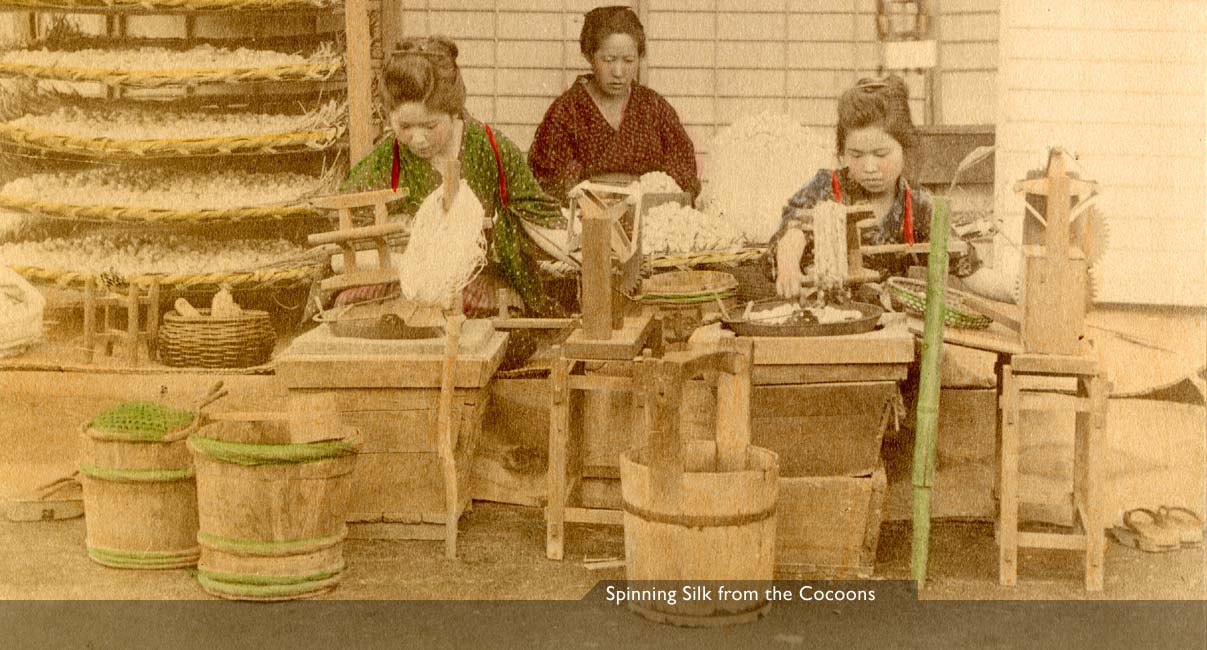
Costumes—Spinning silk
“There is, too, in every cottage a corner for the silk-loom, worked by hand, where back and forth the shuttle flies through the web. It was pleasant to walk through the town and take the peasants unawares at their work. In one cottage I came across a young girl thus weaving at a loom.”

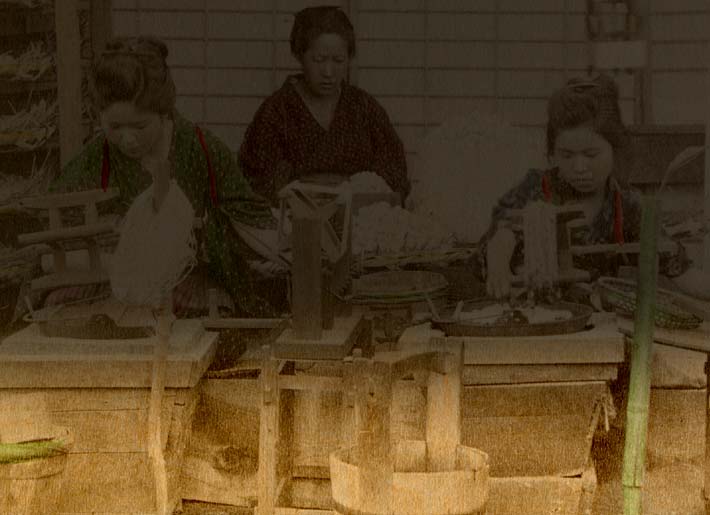
“Tomioka is another center of the silk-growing industry, and in nearly every village through which we passed the majority of the inhabitants were thus engaged. Their primitive processes were very interesting to me. The first step, after you have cocoons, is to unwind them and make a thread. But how is this to be accomplished? A handful of cocoons is thrown into a small pot of water, simmering over a charcoal fire. The hot water appears to loosen the fixed end of the thread, so that when the oerator dabbles about with a bit of broom she picks up half a dozen of almost invisible threads which she fastens to the side of the kettle for use as wanted. Three or four of these she deftly twists into a tiny thread, and fastens it to a reel, and this, turned with the left hand, swiftly unrolls the cocoons. … How many centuries have passed since this crude method of turning a worm’s shroud into a brilliant fabric was first discovered!”
Albert Tracy, Rambles Through Japan Without a Guide, (London, 1892) pp. 43, 74