| |
The Imperial Presence
In 1926, three years after the earthquake, Hirohito inherited the throne and Japan started its calendar over again. The new imperial reign was given the auspicious name Shōwa (Bright Peace), and 1926 became, in this modern Japanese way of calculating the years, Shōwa 1. Hirohito himself was identified most commonly as the Shōwa emperor.
The auspicious reign name was a misnomer, although this was not obvious at first. Hirohito’s father, the Taishō emperor who reigned from 1911 to 1926, had been feeble and incompetent, and the new sovereign’s advisers took care to ensure he would be a more authoritative monarch. There were many reasons for the ruling elites to be concerned about social stability. Liberalizing trends popularly known as “Taishō democracy” had flourished during Hirohito’s father’s reign. Both rightwing and leftwing movements were on the rise. The Kantō earthquake itself had exposed social tensions in the most vicious way imaginable, in the vigilante slaughter of Koreans that took place in its wake. And worse was to come: rising anti-foreign nationalism in China; the collapse of global capitalism in 1929 (and devastating impact of depression on Japan’s rural areas in particular); the successful military conspiracy known as the Manchurian Incident in 1931, and Japan’s withdrawal from the League of Nations in 1933 after that international body condemned its creation of the puppet state of Manchukuo.
Within Japan, the ideological response to this turmoil was to pump emperor-centered nationalism to unprecedented levels. Thus, at the very moment Koizumi and his compatriots were celebrating rebirth, modernity, and the emergence of a truly cosmopolitan metropolis, Tokyo—like the nation as a whole— also was being suffused with a carefully choreographed sense of national, racial, and spiritual uniqueness exemplified by the ubiquitous imperial presence. This is the second strong undercurrent that closer scrutiny of Koizumi’s 100 Views of Great Tokyo in the Shōwa Era reveals.
Some of this was simply conveyed by representations of the Imperial Palace. After 1868, the imperial court was relocated from its traditional base in Kyoto to the newly designated “Eastern Capital” in Tokyo—that is what the two ideographs for Tokyo mean—and the old Edo Castle that had been the seat of power of the Tokugawa shoguns became the new imperial enclave. As originally conceived in plans dating from the early 17th century and laid out in accordance with Chinese geomancy, Edo Castle lay at the heart of the city. As the feudal and then modern city expanded, the sprawling site increasingly fell into its eastern sector.
|
|
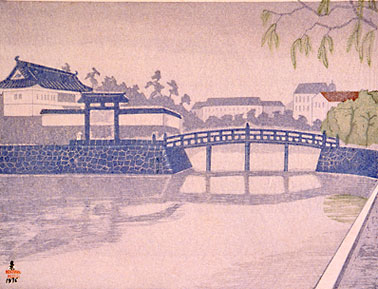
|  In any case, the emperor’s actual “palace” was never seen. Rather, gates, bridges, moats, and other fragments of the old and largely destroyed Edo Castle came to subtly exemplify not only the imperial presence, but also the deeper feudal history of a secluded, isolated land. In any case, the emperor’s actual “palace” was never seen. Rather, gates, bridges, moats, and other fragments of the old and largely destroyed Edo Castle came to subtly exemplify not only the imperial presence, but also the deeper feudal history of a secluded, isolated land. |
“Pagoda of Tennōji Temple
at Yanaka (#78),”
May 1936
|
| |
In 1935 and then again five years later, as he brought his “100 Views” to a close, Koizumi produced two versions of a particularly puzzling site: the feudal-era execution grounds at Suzugamori.
|
|
“Nijū Bridge on New Year’s Day (#21),”
January 1932
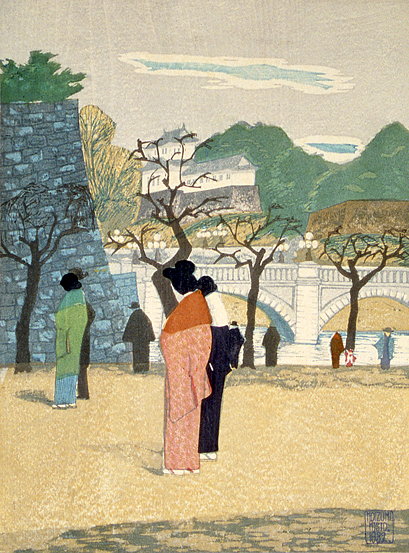
This stone bridge, built in 1887, was the primary ceremonial bridge that the emperor and important visitors used to enter the grounds of the palace. It survived the earthquake to become another symbol of continuity.
| 
|
| |
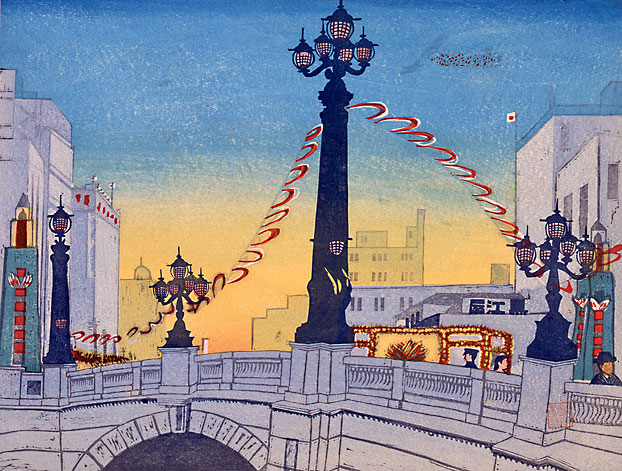
Other representations of the imperial presence were even more indirect. Several prints, for example, depict sites associated with commemoration of Hirohito’s grandfather, the Meiji emperor (#9, #72). Yasukuni Shrine (#19), a major landmark in anyone’s rendering of the modern city, was established by the new Meiji government in the 1870s to promote State Shinto and venerate the souls of all who died fighting for the emperor. Koizumi’s annotation for his rendering of the famous Nihonbashi bridge tells us that the festive decorations he includes are celebrating “the birth of the Crown Prince.” (Hirohito’s first son and later successor, Akihito, was born on December 23, 1933, and Koizumi’s print is dated January 1934.)
|
|
“Nihon Bridge on a Holiday (#44), January 1934,”
The holiday being celebrated was “the birth of the
Crown Prince” the previous month. |
| |
Koizumi’s print of the Akasaka detached palace, where guests of state resided and whose spacious grounds included the residences of imperial princes, adds additional layers of allusion to the imperial presence. This rather bizarre Versailles-like structure—a bit of old Europe in the middle of Tokyo—reflects the degree to which the modern monarchy sought architectural justification and resonance by quoting European palaces and halls of state.
|
|
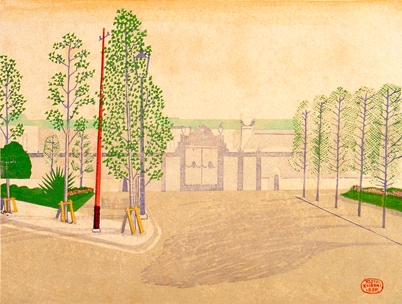
| Koizumi’s notation calls it “beautiful like a palace in a fairyland”—and goes on to observe that Pu Yi, the puppet emperor of Manchukuo, stayed there two times.” |
“Detached Palace [Akasaka]
(Formerly Palace of
Crown Prince) (#52),”
June 1934
|
| |
The captions to two other prints (#18, #26) make reference to the emperor’s brother Prince Chichibu, who was known to have close ties with some of the most radical rightwing officers in the military.
|
|
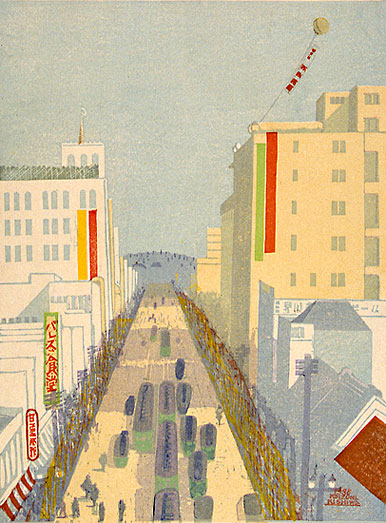
The most subtle evocation of the imperial presence is to be found in one of Koizumi’s most attractive renderings of urban élan: his bird’s-eye view of the main avenue in the bustling Shinjuku district. Great department stores flank the street (Isetan on the left, Mitsukoshi on the right). An advertising balloon hovers in the sky. Tiny pedestrians and abstracted vehicles fill the thoroughfare.
| 
|
“Street at Shinjuku (#61),”
April 1935
Koizumi’s caption describes this part of Shinjuku as a fashionable place “for the intellectual class to gather.” What he did not mention is that the bustling avenue in this print terminates at the imperial palace.
|
| |
And the imperial presence? This resides in the distant “vanishing point” of Koizumi’s rendering of the thoroughfare, which all Tokyo residents would recognize to be the Hanzomon gate of the Imperial Palace. Unobtrusively, the imperial presence oversees the prosperity of the nation.
|
|
* * *
From ”Tokyo Modern I: Koizumi Kishio’s 100 Views
of the Imperial Capital (1928–1940)“ by James T. Ulak, chapter lV
MIT Visualizing Cultures
Images courtesy of The Wolfsonian–FIU, Miami Beach, FL,
The Mitchell Wolfson, Jr. Collection
|
|