 |
|
|
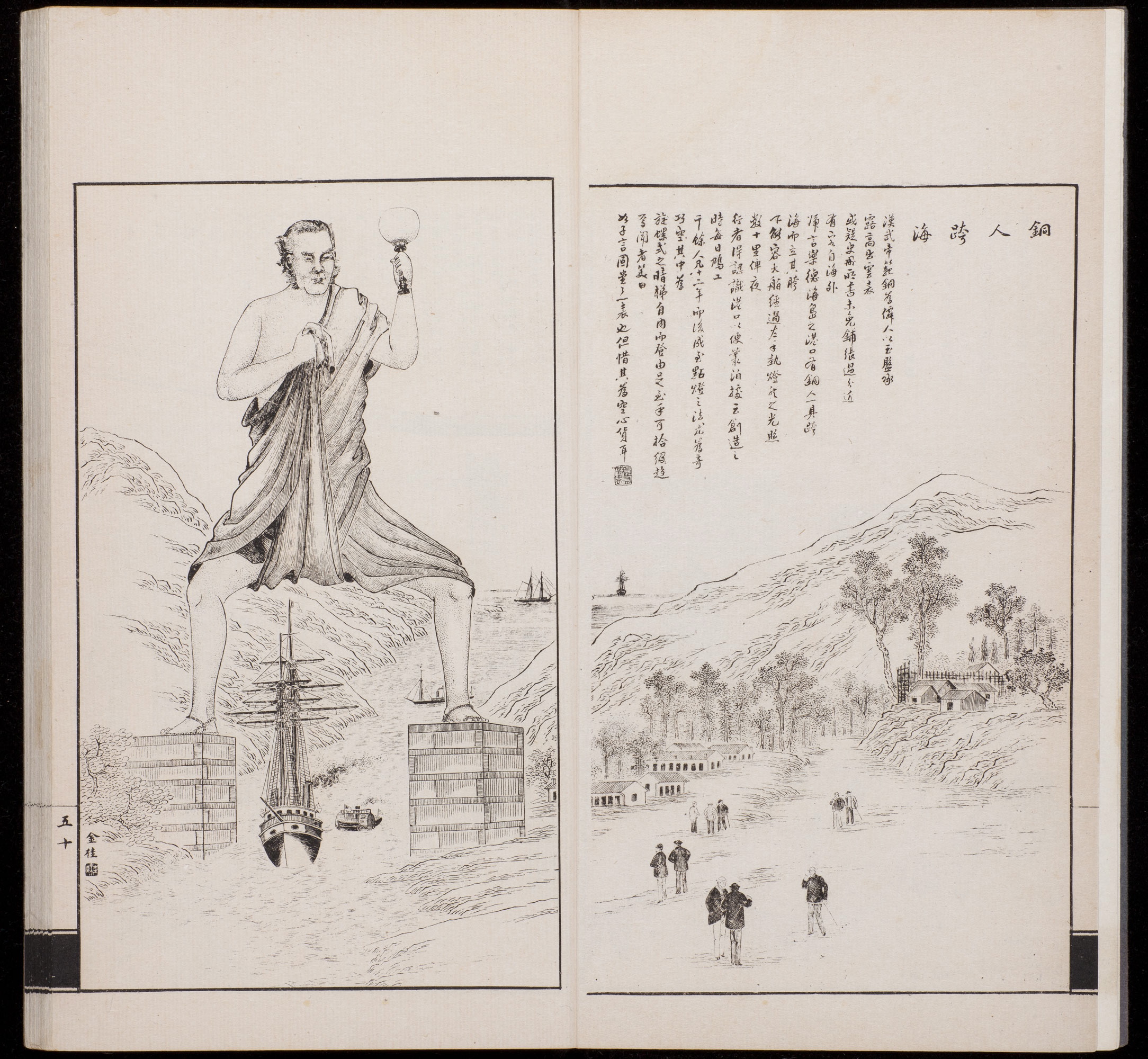
 Title: “Bronze Figure Bestrides the Strait” 銅人跨海 Year: ca. 1887 Volume: 16 Page Number: 2 Caption Translation: Emperor Wu of the Han Dynasty once cast a bronze figure that was higher than the clouds and used a jade plate to hold the dew. Many have doubted the authenticity, or possible exaggerations, of this historical account. Lately, a traveler returning from abroad said that, at the port of Rhodes, there is a bronze figure standing over the strait, and that huge vessels can pass easily between his legs. The figure holds in his left hand a lamp that can illuminate an area as far as 5 miles, so that night travelers would still be able to recognize the port and anchor their vessels. Reportedly, it took the labor of one thousand workers per day and twelve years in total to build this bronze figure. The method of lighting the lamp is very smart: inside the figure there are spiral staircases, which one can use to climb up to the left hand. People who heard about this method joked about it: “If it is really the case, what a pity for someone so handsome to be a hollow, heartless creature!” Translator: Flora Shao |
Caption Text: 離鹽城縣治十餘里有一地, 名田港塢, 周圍數十畝葭菼蒙茸, 濱海隙地也。 今歲夏五月二十八日晚, 狂風暴雨, 海水陡漲灘壖, 變為澤國。 異日潮落, 有一巨魚偃卧灘頭, 宛若虹隄, 鱗甲完而兩睛失矣。 觀者環擁如牆, 土人臠其肉而烹之, 鮮美可口, 其骨中椽據耆。 老云歲逢閏月海中必推出大魚, 俗所謂推魚暴也, 嗟乎吞舟。 昔日鯨鯢逞海, 國之威失水, 今朝 鬵釜果編氓之腹, 觀是魚也可以興矣。 View on Yale Visual Resources |
|
|  |
|
|
| illustrations from the 1898 edition of the Dianshizhai huabao, generously provided by the Sterling Memorial Library at Yale University Massachusetts Institute of Technology © 2015 Visualizing Cultures  |
| “Bronze Figure Bestrides the Strait” 銅人跨海 ca. 1887 artist Jin Gui (Jin Chanxiang) (page 2) [dz_v16_003] |