 |
|
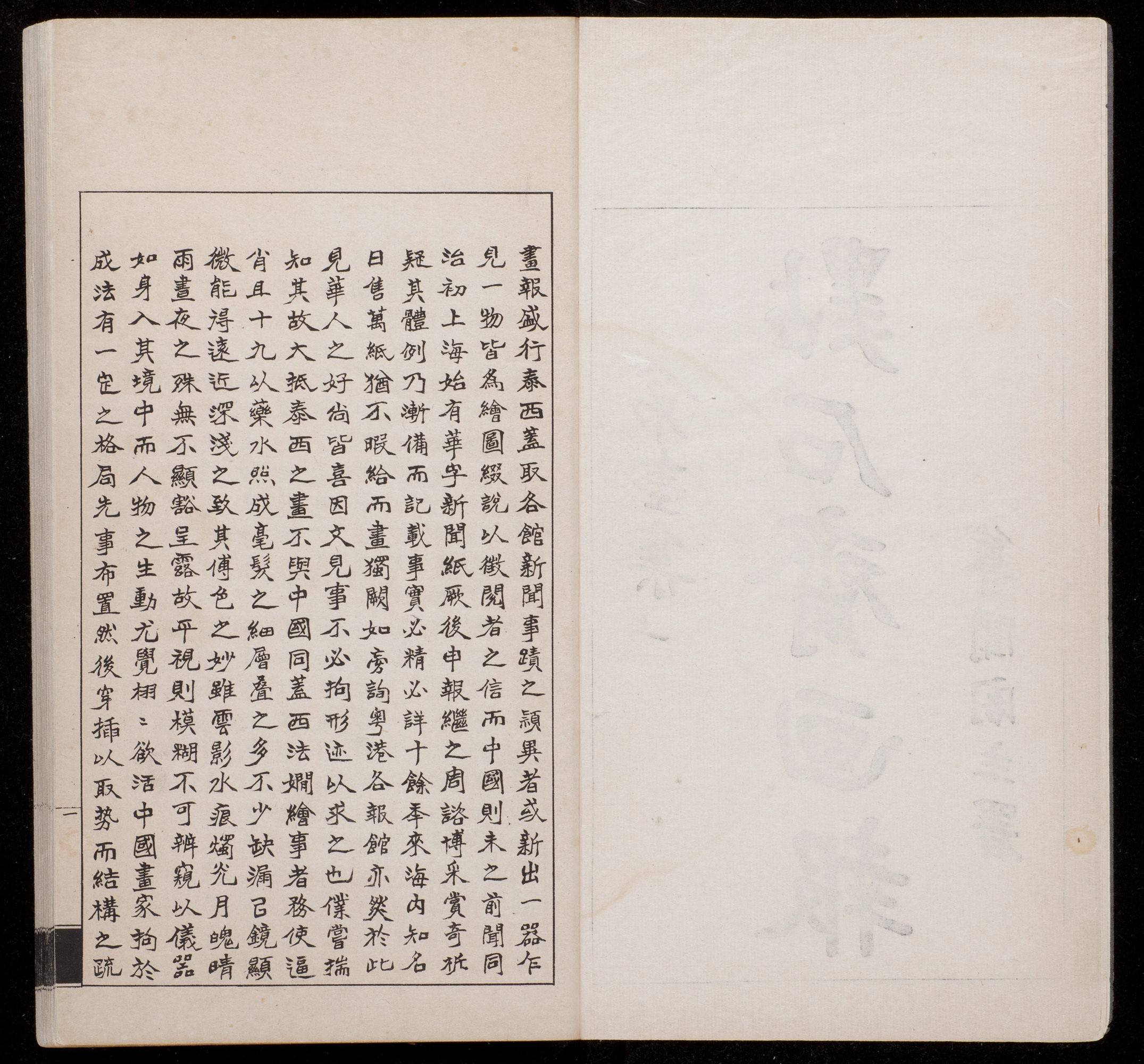
 Title: Preface Year: 1884 Volume: 1 Issue: 1 Page Number: 1, 2 Caption Translation: Illustrated papers are quite popular in the West. They generally select the most unusual items from various newspapers, such as a new device, or a newly sighted thing. They make drawings of them and add explanations In order to convince their readers. China, however, has never had such papers. In the beginning of the Tongzhi era (1862), the first Chinese-language newspaper appeared in Shanghai; then the Shenbao continued it. Now it practices all-enclusive reportage, selecting from a broad range of material, with features of general interest and special attention to curiosities. Its form of presentation has gradually improved, and it presents the facts elegantly and in great detail. During the last decade or so, the Shenbao has become widely known within China, with ten thousand copies sold daily. Still, we had no spare time to provide illustrations. It turned out that the same was true for the Canton and Hong Kong papers. This shows that the Chinese rather enjoy studying the world through texts and do not see the need to explore it in visual form. |
I have endeavored to look into the causes for this. Generally speaking, Western drawing is different from Chinese. Those accomplished in drawing using the Western method [with copper engravings] will strive to get a close likeness. Nearly all of them will use an acid for highlighting, and even in details as fine as the finest hair and with a multitude of different layers [in the perspective], they still leave small spaces [between the lines]. With a magnifying glass one can fully appreciate their achievements in portraying space and depth. Their sophistication in laying on colors is such that minute particulars—shadows of clouds, ripples in the water, the glow of a candle, the dark parts of the moon, clear weather and rain, morning and night—all will be clearly visible. Therefore, if one just glances at [these illustrations], it is hard to make out all the details in the dense texture, but once one looks at them with an instrument [a magnifying glass] then it is as if one was personally entering into the scene, where the people act as if they were all alive. |
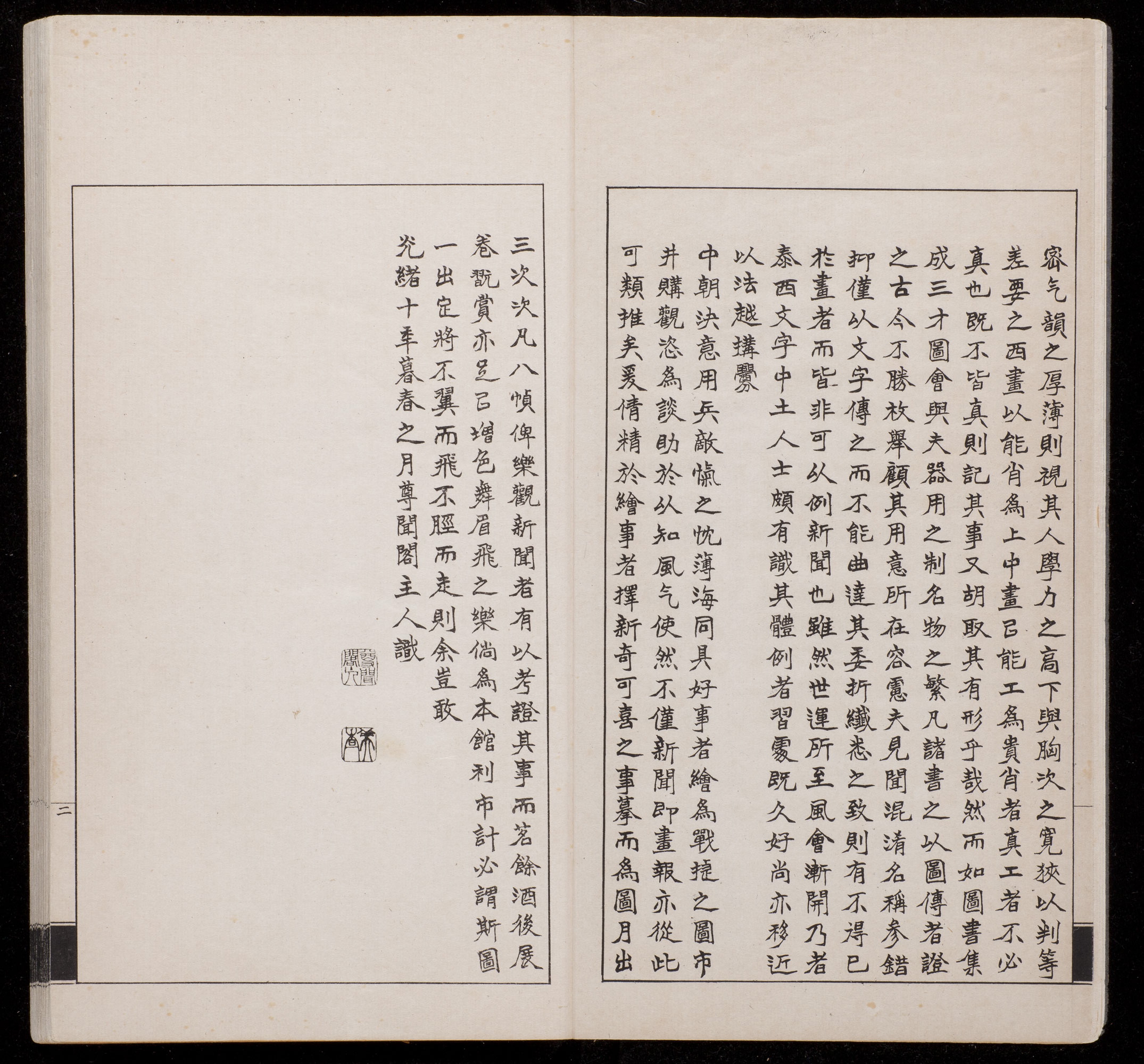
The Chinese painter [on the other hand] goes by established rules and has a set style. First of all he sets out the basic structure, and then fills it in to capture the impression. It is in the coherence of the framework and the richness of the atmosphere that one will recognize the [painter's] erudition and the breadth of his inspiration so that one can rank his skill. To sum up, the Western painter will set a premium on his capacity to imitate, while the Chinese painter most highly esteems technique. Imitation must present the truth, while technique need not render the true [features]. But if [painting] is not altogether true to the [original], what is the use of supplementing the [written] report of an event with an illustration? However, [Chinese] works such as the [Gujin] Tushu jicheng and the Sancai Tuhui do show how instruments work and display a variety of renowned artifacts. So there are innumerable examples of illustrated books from ancient and modern times. What is the purpose [of this combination of text and image]? If, faced with a confused melange of information, one relies solely on writing to report it, one will be quite unable to convey it in all its intricacies. In some situations, it is simply impossible to deliver the news without using illustrations. |
However, with the changing times fixed habits gradually alter, so there are now gentlemen from China who have considerable understanding of the form of Western writings. As their familiarity grows with time, their tastes have been transformed. Recently, because the Chinese court has decided to deploy its soldiers in the struggle between France and Vietnam, deep hatred for the enemy has swept through the land. Avid supporters have drawn pictures of victories in this war, which are sold and viewed in the market places, and quite easily become materials for debate, shaping public opinion. We can infer opinion not only from the written news, but also from the illustrated leaflets. I have therefore hired people with fine skills in drawing to illustrate sensational and entertaining scenes. We will publish three issues per month. As a rule each issue will have eight pages, so that those who enjoy the written news can refer to it. But when browsing it for relaxation after drinking tea or wine, [this illustrated paper] will also light up your faces with joy. |
As for the market [for our paper], we may say with confidence that once these drawings are published, they will literally fly off the shelves. What more can I say? Guangxu tenth year in the last month of spring [May 1884] communicated by the Master of the "Appreciate News Studio" (i.e. Ernest Major). Seal 1: Master of the Appreciate News Studio Seal 2: Meicha [Major] Translator: Rudolf Wagner, revised by Peter C. Perdue Comments: This translation is based on Rudolf G. Wagner, Joining the Global Public: Word, Image, and City in Early Chinese Newspapers, 1870-1910 (Albany, N.Y.: State University of New York Press, 2007), pp. 132-134. View on Yale Visual Resources [p01] View on Yale Visual Resources [p02] |
|
|  |
 |
|
|
| Images: Yale University Library, East Asia Library Massachusetts Institute of Technology © 2015 Visualizing Cultures  |
| Preface (page 1) 1884 [dz_v01_003] |
Preface (page 2) 1884 [dz_v01_04] |